

An Electron Has A Mass
| Constant | Values | Units |
|---|---|---|
| m e | 9.109383 7015(28)×x−31 [1] | kg |
| 5.485799 090 65(xvi)×10−iv [2] | Da | |
| 0.510998 950 00(xv) | MeV/c 2 | |
| m e c two | viii.187105 7769(25)×10−xiv | J |
| 0.510998 950 00(15) [three] | MeV |
The electron mass (symbol: m e ) is the mass of a stationary electron, also known as the invariant mass of the electron. It is one of the cardinal constants of physics. It has a value of about 9.109×10⁻³¹ kilograms or most 5.486×10⁻⁴ daltons, which has an energy-equivalent of about 8.187×10−xiv joules or about 0.511 MeV.[3]
Terminology [edit]
The term "residue mass" is sometimes used because in special relativity the mass of an object tin be said to increase in a frame of reference that is moving relative to that object (or if the object is moving in a given frame of reference). Virtually applied measurements are carried out on moving electrons. If the electron is moving at a relativistic velocity, whatsoever measurement must use the correct expression for mass. Such correction becomes substantial for electrons accelerated by voltages of over 100 kV.
For example, the relativistic expression for the total energy, E, of an electron moving at speed is


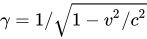
where the Lorentz gene is . In this expression m e is the "rest mass", or more simply merely the "mass" of the electron. This quantity chiliad e is frame invariant and velocity independent. However, some texts group the Lorentz cistron with the mass factor to define a new quantity called the relativistic mass, m relativistic = γm east .
Conclusion [edit]
Since the electron mass determines a number of observed effects in atomic physics, there are potentially many means to determine its mass from an experiment, if the values of other concrete constants are already considered known.
Historically, the mass of the electron was adamant direct from combining ii measurements. The mass-to-charge ratio of the electron was first estimated by Arthur Schuster in 1890 by measuring the deflection of "cathode rays" due to a known magnetic field in a cathode ray tube. Seven years afterwards J. J. Thomson showed that cathode rays consist of streams of particles, to be chosen electrons, and made more precise measurements of their mass-to-accuse ratio again using a cathode ray tube.
The second measurement was of the charge of the electron. This was determined with a precision of meliorate than ane% past Robert A. Millikan in his oil drop experiment in 1909. Together with the mass-to-accuse ratio, the electron mass was determined with reasonable precision. The value of mass that was found for the electron was initially met with surprise by physicists, since information technology was so small (less than 0.1%) compared to the known mass of a hydrogen cantlet.
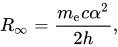
The electron rest mass tin can be calculated from the Rydberg constant R ∞ and the fine-construction constant α obtained through spectroscopic measurements. Using the definition of the Rydberg constant:
thus
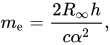
where c is the speed of light and h is the Planck constant.[4] The relative dubiety, five×10−8 in the 2006 CODATA recommended value,[5] is due entirely to the uncertainty in the value of the Planck abiding. With the re-definition of kilogram in 2019, there is no uncertainty by definition left in Planck constant anymore.
The electron relative atomic mass can be measured directly in a Penning trap. Information technology tin can also exist inferred from the spectra of antiprotonic helium atoms (helium atoms where ane of the electrons has been replaced by an antiproton) or from measurements of the electron yard-factor in the hydrogenic ions 12C5+ or sixteenO7+.
The electron relative atomic mass is an adjusted parameter in the CODATA set of central physical constants, while the electron rest mass in kilograms is calculated from the values of the Planck constant, the fine-structure constant and the Rydberg constant, as detailed above.[4] [5]
Relationship to other concrete constants [edit]
The electron mass is used to calculate[ commendation needed ] the Avogadro constant Northward A:

Hence information technology is as well related to the diminutive mass constant m u:

where G u is the molar mass constant (defined in SI) and A r(e) is a directly measured quantity, the relative diminutive mass of the electron.
Annotation that m u is defined in terms of A r(east), and not the other way round, then the proper name "electron mass in atomic mass units" for A r(e) involves a circular definition (at to the lowest degree in terms of practical measurements).
The electron relative atomic mass besides enters into the calculation of all other relative diminutive masses. By convention, relative diminutive masses are quoted for neutral atoms, only the bodily measurements are made on positive ions, either in a mass spectrometer or a Penning trap. Hence the mass of the electrons must be added back on to the measured values before tabulation. A correction must also be made for the mass equivalent of the binding energy E b. Taking the simplest case of complete ionization of all electrons, for a nuclide 10 of atomic number Z,[4]

As relative diminutive masses are measured as ratios of masses, the corrections must be applied to both ions: the uncertainties in the corrections are negligible, as illustrated beneath for hydrogen 1 and oxygen sixteen.
| Physical parameter | 1H | xviO |
|---|---|---|
| relative diminutive mass of the X Z+ ion | 1.007276 466 77(10) | fifteen.990528 174 45(eighteen) |
| relative diminutive mass of the Z electrons | 0.000548 579 909 43(23) | 0.004388 639 2754(18) |
| correction for the binding energy | −0.000000 014 5985 | −0.000002 194 1559 |
| relative atomic mass of the neutral atom | one.007825 032 07(10) | 15.994914 619 57(18) |
The principle tin exist shown by the determination of the electron relative diminutive mass past Farnham et al. at the University of Washington (1995).[half dozen] Information technology involves the measurement of the frequencies of the cyclotron radiation emitted by electrons and past 12C6+ ions in a Penning trap. The ratio of the 2 frequencies is equal to six times the inverse ratio of the masses of the 2 particles (the heavier the particle, the lower the frequency of the cyclotron radiation; the higher the charge on the particle, the college the frequency):

As the relative atomic mass of 12C6+ ions is very nearly 12, the ratio of frequencies can be used to summate a starting time approximation to A r(e), 5.486303 7178 ×10−four . This approximate value is then used to calculate a first approximation to A r(12Chalf-dozen+), knowing that Due east b(12C)/yard u c 2 (from the sum of the half-dozen ionization energies of carbon) is 1.1058674 ×10⁻⁶ : A r(12C6+) ≈ xi.996708 723 6367 . This value is then used to calculate a new approximation to A r(e), and the process repeated until the values no longer vary (given the relative uncertainty of the measurement, 2.1×10⁻⁹): this happens past the quaternary bike of iterations for these results, giving A r(east) = five.485799 111(12)×x−4 for these data.
References [edit]
- ^ "2018 CODATA Value: electron mass". The NIST Reference on Constants, Units, and Uncertainty. NIST. 20 May 2019. Retrieved 2019-05-twenty .
- ^ "2018 CODATA Value: electron mass in u". The NIST Reference on Constants, Units, and Uncertainty. NIST. 20 May 2019. Retrieved 2020-06-21 .
- ^ a b "2018 CODATA Value: electron mass energy equivalent in MeV". The NIST Reference on Constants, Units, and Uncertainty. NIST. xx May 2019. Retrieved 2022-07-11 .
- ^ a b c "CODATA Value: electron mass". The NIST Reference on Constants, Units and Uncertainty. May 20, 2019. Retrieved May 20, 2019.
- ^ a b The NIST reference on Constants, Units, and Uncertainty, National Constitute of Standards and Technology, ten June 2009
- ^ Farnham, D. Fifty.; Van Dyck Jr., R. S.; Schwinberg, P. B. (1995), "Determination of the Electron's Diminutive Mass and the Proton/Electron Mass Ratio via Penning Trap Mass Spectroscopy", Phys. Rev. Lett., 75 (20): 3598–3601, Bibcode:1995PhRvL..75.3598F, doi:x.1103/PhysRevLett.75.3598, PMID 10059680

An Electron Has A Mass,
Source: https://en.wikipedia.org/wiki/Electron_mass
Posted by: jenningswhad1962.blogspot.com
0 Response to "An Electron Has A Mass"
Post a Comment